
Invoicing · 27 August 2026 · 8 min read
Australian Sole Trader Invoicing Guide
A free Australian sole trader invoice template you can copy, plus what the ATO expects on an invoice and when it becomes a tax invoice.
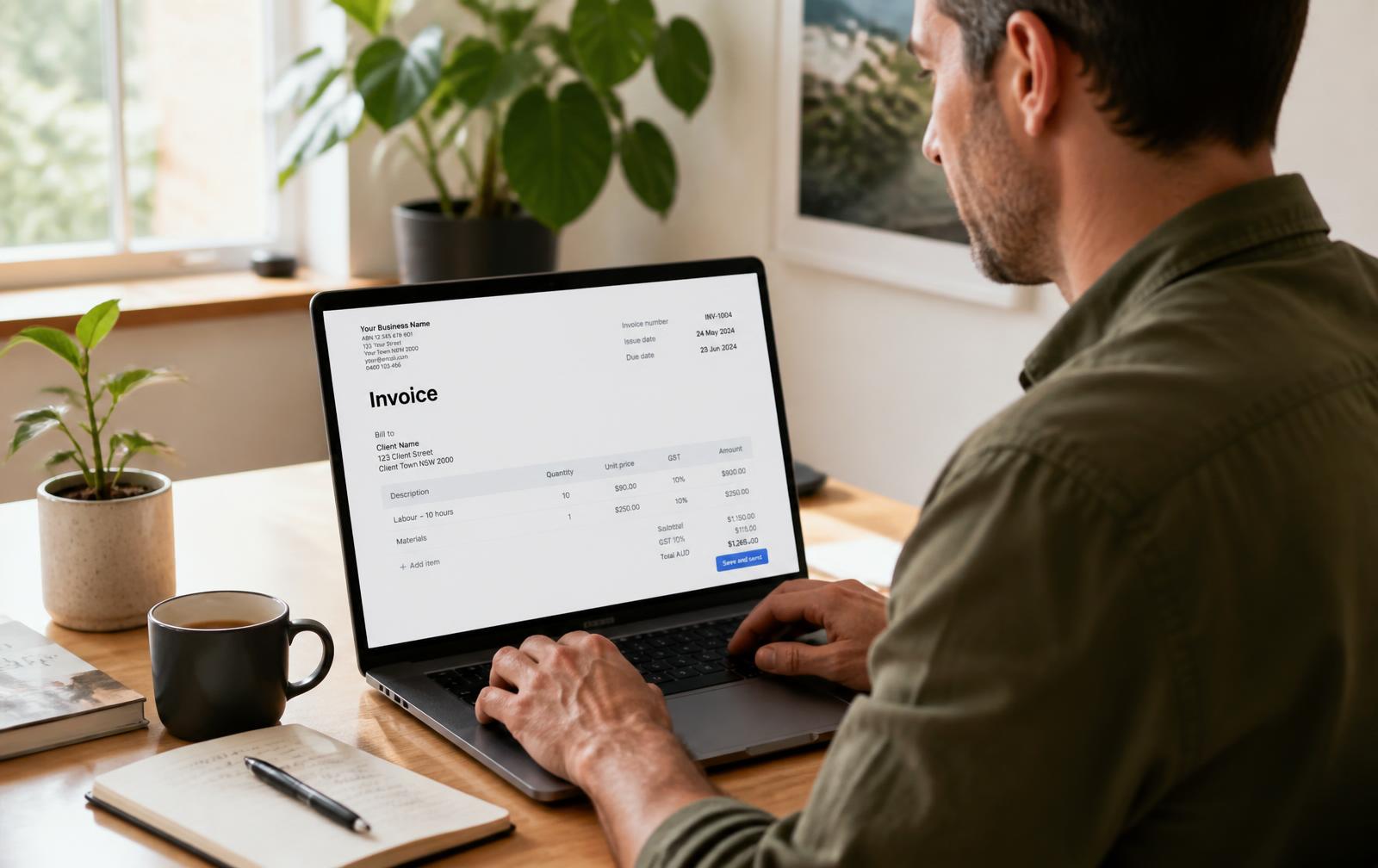
Most sole traders start out invoicing from a document they copied from somewhere — a Word file, a spreadsheet, or a note on their phone. It works until a client asks for an ABN, or until you need to find out which invoices are still unpaid.
This guide sets out what an Australian sole trader invoice needs to include, gives you a template you can copy, and explains the difference between a plain invoice and a tax invoice if you are registered for GST.
What an Australian sole trader invoice must include
The Australian Taxation Office sets out what has to appear on an invoice. For a sole trader who is not registered for GST, you are issuing a regular invoice, and it should include:
- the word “Invoice” clearly shown
- your name or business name
- your ABN
- the date you issued the invoice
- a description of the goods or services, including quantity and price
- the client's name (and their business details if relevant)
- the total amount payable in AUD
- your payment terms and payment details
If you are not registered for GST, do not charge GST and do not label the document a tax invoice. It is helpful to state something like “No GST has been charged” so the client understands the total.
What changes when you are registered for GST
Once you are registered for GST, invoices for taxable sales become tax invoices and need extra detail:
- the words “Tax invoice”
- the GST amount for the sale, either per line or as a single total
- a statement such as “Total price includes GST”
- the buyer's identity or ABN when the sale is for $1,000 or more (excluding GST)
GST registration is generally required once your business turnover reaches $75,000 in a financial year, and you can register voluntarily below that. Check current thresholds and wording on the ATO website, because these rules change from time to time.
A copy-and-paste sole trader invoice template
Use this as a starting point. Replace the bracketed parts, and delete the GST lines if you are not registered.
TAX INVOICE

[Your name / business name]
ABN: [11 222 333 444]
[Address]  ·  [Email]  ·  [Phone]

Invoice number: INV-0001
Invoice date: [DD/MM/YYYY]
Due date: [DD/MM/YYYY]  (e.g. 14 days from issue)

Bill to:
[Client business name]
[Client contact name]
[Client ABN, if the sale is $1,000 or more]
[Client address / email]

-------------------------------------------------------------
Description                     Qty    Unit price     Amount
-------------------------------------------------------------
[Consulting — project scope]     10       $120.00   $1,200.00
[Travel — site visit]             1        $80.00      $80.00
-------------------------------------------------------------
                                        Subtotal:   $1,280.00
                                     GST (10%):       $128.00
                                    Total (AUD):    $1,408.00
Total price includes GST.

Payment details
Account name: [Name]
BSB: [000-000]   Account: [00000000]
Reference: INV-0001

Terms: Payment due within 14 days of the invoice date.
Thank you for your business.
If you are not registered for GST, change the heading to “Invoice”, remove the GST line, and add “No GST has been charged” under the total.
Numbering, terms and the details that get you paid
Give every invoice a unique number
A simple sequence works best: INV-0001, INV-0002, and so on. Some sole traders prefix with initials or the year. The rule that matters is that numbers are unique and never reused, so you and your accountant can trace any payment back to the work.
State your payment terms on the invoice
“Payment due within 14 days” is clearer than “due on receipt”. Put the due date on the invoice as a date, not just a number of days, and include your bank details and a reference so the client does not have to ask.
Keep a copy of every invoice you issue
Business records generally need to be kept for five years. Store issued invoices somewhere you can search them later — see our guide on sole trader record keeping for what else to keep.
When a template stops being enough
A template is fine for your first few invoices. It starts to creak when you need to answer questions like: which invoices are unpaid, how much have I earned this financial year, and where is the receipt for that expense?
- You retype the same details every time and typos creep into your ABN or bank details.
- You cannot tell at a glance what is outstanding.
- Invoiced income lives in one place and expenses live in another.
- At tax time you rebuild the year from bank statements.
That is what Indi is for: your business details and logo are saved once and applied to every invoice, numbering continues automatically, unpaid invoices are tracked, and your invoiced income flows into your Tax Pack for the financial year. You can also build reusable line-item templates for the work you quote repeatedly, and add a “Pay now” button linked to your Stripe or PayPal payment link.
Read more about invoicing software for sole traders, or try it with demo data first.